The canonical substation namespace is gdm.systems.substation:
from gdm.systems.substation import (
    CircuitBreaker,
    PowerTransformer,
    SubstationSystem,
)
SubstationSystem is the authoritative data model for utility station topology
and station data. It covers distribution substations, wind collector
substations, solar collector substations, hybrid renewable substations, and
colocated energy storage interfaces.
For the distinction between system models and guidance on choosing or joining them, start with the System Models overview. This page documents the station model itself.
Quick Start
Build a complete reusable example with the public substation namespace:
from gdm.systems.substation import build_reference_design

station = build_reference_design("detailed_distribution")
The result is a SubstationSystem, not a DistributionSystem. It includes the
station’s incoming circuits, transformers, feeder boundaries, protection,
metering, and automation. Use the reference-design tutorial
to choose a topology, or use SubstationBuilder when constructing a custom
station.
Ownership Boundary
DistributionSystem owns feeder-level analysis: distribution buses, lines,
loads, DER, feeder topology, and distribution time series. SubstationSystem
owns station topology and design: substations, voltage levels, bays, busbar
sections, primary equipment, protection, metering, station automation, SCADA
mappings, and renewable plant interconnection profiles.
Station topology uses the same bus-branch design as DistributionSystem.
Electrical nodes are BusbarSection instances, which subclass DistributionBus
and use the inherited geographic coordinate for mapping. Installed equipment
references the nodes it connects directly through typed buses (series) or
bus (shunt) fields; there
are no string terminal or connectivity-node IDs inside the station. Cross-system
references (distribution feeder IDs, plant IDs, protocol addresses) remain
strings.
For an operational feeder model, DistributionSystem can replace one stored
DistributionTransformer with a SubstationSystem via
replace_transformer_with_substation(). The station system must expose exactly
one FeederBoundary whose feeder_id matches the transformer’s
DistributionFeeder.name; it supplies the PowerTransformer, BusbarSection
nodes, and two-terminal equipment such as breakers or disconnectors. The
original transformer is removed, while its high-side voltage source and
terminal buses remain in the distribution system. Breaker and disconnector
state then participates in directed-topology reachability.
DistributionSystem.get_substation_feeder_subsystem() returns a new
distribution model containing only components whose DistributionFeeder.name
matches a FeederBoundary.feeder_id in a supplied SubstationSystem. This
supports selecting one or more station outfeeds without modifying the original
distribution model.
SubstationSystem.to_distribution_system() assembles a complete distribution
model from the station topology and a list of single-feeder distribution models.
Each FeederBoundary.source_equivalent_id identifies the feeder root bus by
name. The root bus is merged into the boundary bus, feeder-local voltage sources
are removed, and one source is created at the highest-voltage station
transformer bus.
SubstationSystem.get_undirected_graph() returns a NetworkX bus-branch graph
whose nodes are busbar sections and whose edges are state-aware primary
equipment, ready for SCADA binding.
Reference Designs
build_reference_design() exposes reusable single-bus, sectionalized,
main-and-transfer, double-bus, ring-bus, breaker-and-a-half,
double-breaker/double-bus, and HV/MV layouts. The same API also exposes the
"detailed_distribution" design, a complete 69/12.47 kV station with two
infeeds, two transformers, four outfeeds, protection, metering, and station
automation. Canonical layouts accept an outfeed_count and a
coordinate_provider; callers can supply geographic Location values or a
deterministic schematic placement.
Model Relationships
The diagram separates system registration from the typed object references that carry facility structure and electrical connectivity. It presents the core models plus representative protection, metering, and automation links; the corresponding reference models are shown as a grouped boundary.
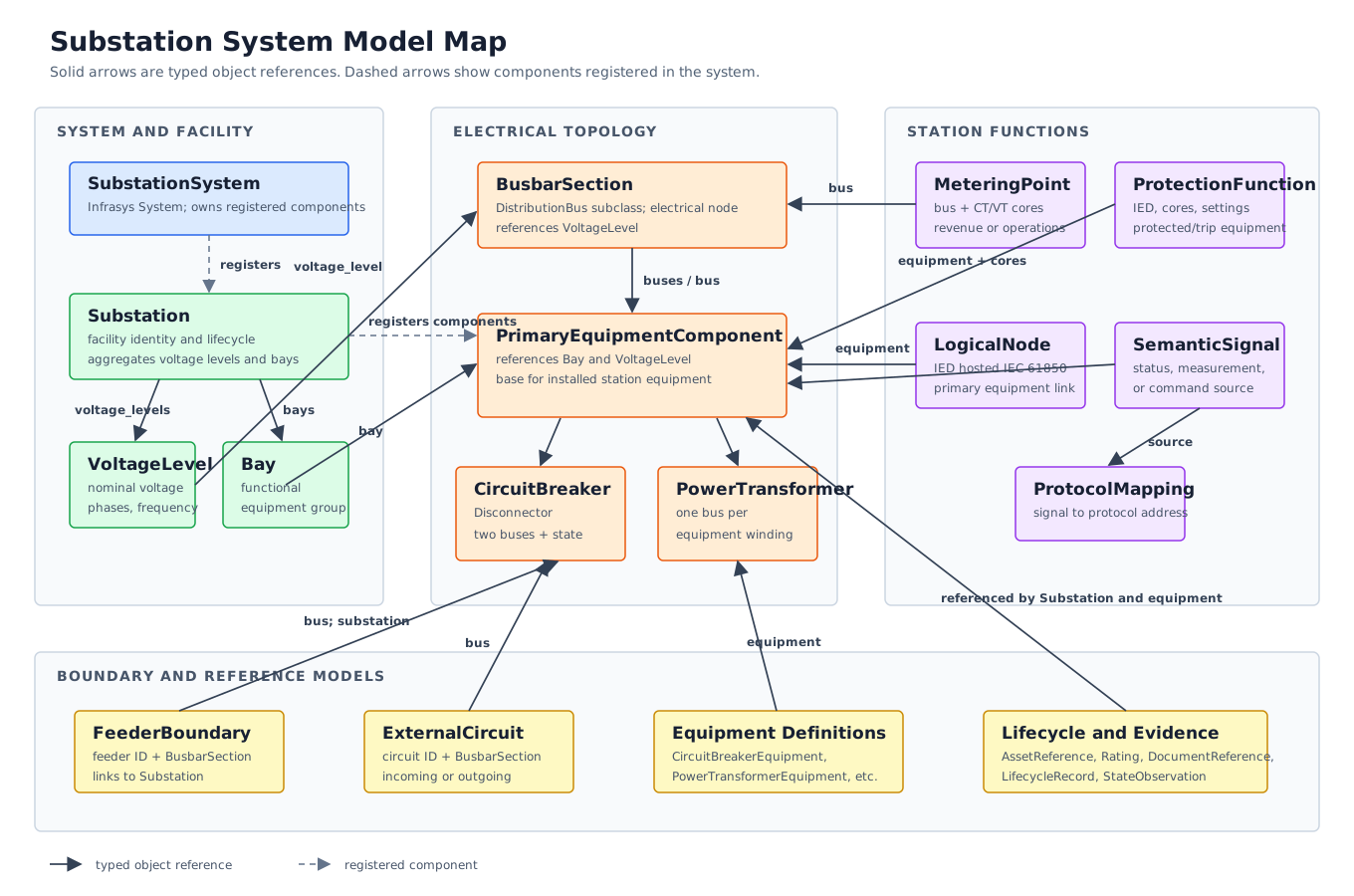
Scope
The current datamodels include:
station topology: substations, voltage levels, bays, busbar sections (nodes), feeder boundaries, and bus-branch primary equipment;
primary equipment: breakers, disconnectors, earthing switches, power transformers, instrument transformers, and surge arresters;
protection: IEDs, functions, schemes, setting groups, settings, and test records;
automation: IEDs, IEC 61850 logical nodes, SCL metadata, semantic signals, and DNP3/IEC 60870/IEC 61850 mappings;
metering and power quality: instrument-transformer cores, metering points, meter tests, and PQ monitors;
renewable interfaces: collector feeders, plant controllers, IEEE 1547/IEEE 2800 profiles, solar/wind plant references, and energy-storage interfaces;
lifecycle and evidence: asset references, external identifiers, ratings, standards profiles, document metadata, lifecycle records, and state observations.
SCL, relay-settings, SCADA, and study files are represented by metadata and hash/URI references only. File parsing and external utility integrations are outside the current scope.
Plotting
SubstationSystem.to_gdf()returns a combined GeoDataFrame containing point records for positioned busbar sections and line records for connected primary equipment. It can also export the table as CSV.SubstationSystem.to_geojson(path)exports the same topology as GeoJSON.SubstationSystem.plot()renders the GeoDataFrame as an interactive map. Its node and edge color choices, map type, map style, legend control, zoom level, and directory-based HTML export followDistributionSystem.plot(); coordinate flipping is not supported for substation maps.
Standards Profiles
The model is generic by default. Projects can associate applicable editions and
authorities with StandardProfile, including profiles based on:
IEEE 1547-2018 for distribution-connected DER;
IEEE 2800-2022 for transmission/subtransmission IBR interfaces;
IEEE C37.2-2022 for protection and device function vocabulary;
IEC 61850 and IEC 61850-6 for station automation and SCL;
IEC 61970/61968 CIM for utility information-model exchange;
IEEE 519-2022 and IEC 61000 profiles for power quality.
Standards applicability, adopted editions, utility requirements, and authority having jurisdiction remain project data rather than global assumptions in the model.